Van tax for tradesmen: sole traders, limited companies and the 2026/27 rates
How van tax works for UK tradesmen in 2026/27: what sole traders claim, the £4,170 company van benefit, the commuting rule, electric vans and VAT on the van.
By Kian McKiernan, founder of Traddie. Sources linked throughout; see also our editorial policy.
It depends how you trade
Van tax works completely differently for sole traders and for limited companies. Sole traders claim the van as a business cost and never pay benefit in kind. Directors and employees of a limited company that provides a van may pay benefit in kind on it. Most of the confusion comes from mixing the two up.
If you only want the figure for a company van, the company van tax calculator works it out.
Sole traders: claiming the van
As a sole trader, you and the business are the same person, so there is no benefit to tax. Instead you claim the van against your profits in one of two ways, and once you pick one for a vehicle you stick with it.
- Actual costs: capital allowances on the purchase, plus fuel, insurance, repairs, tax and servicing, with a deduction for private use.
- Simplified expenses: a flat rate per business mile. For 2026/27, HMRC's rate is 55p a mile for the first 10,000 business miles and 25p after that. You can't use it on a van you have claimed capital allowances on.
Capital allowances on a van
Vans count as plant and machinery, not cars, so they qualify for the Annual Investment Allowance, which lets you deduct up to £1 million of qualifying spending from your profits in the year you buy. For most trades that means the whole cost of the van comes off profit in year one. Sole traders must reduce the claim by the proportion of private use.
Double cab pickups are the exception. Since April 2025, HMRC treats most of them as cars for capital allowances and benefit in kind, whatever the payload, so they don't get the Annual Investment Allowance. There are transitional rules for ones bought earlier, so check before you buy one for the tax treatment.
Limited companies: the van benefit charge
If your company provides a van and it is used privately beyond what HMRC calls insignificant, the person using it has a taxable benefit. For 2026/27, HMRC's figures are:
- Van benefit charge: £4,170, a flat amount whatever the van is worth.
- Van fuel benefit charge: £798, only if the company pays for private fuel.
- Fully electric vans: nil.
What it actually costs
The charge is the amount you are taxed on, not the tax itself. A basic rate taxpayer pays 20% of £4,170, which is £834 a year, or £993.60 with the fuel benefit added. A higher rate taxpayer pays 40%, which is £1,668 a year, or £1,987.20 with fuel. The company also pays Class 1A National Insurance on the benefit.
The commuting rule that saves directors money
Ordinary commuting between home and work in a company van doesn't trigger the van benefit charge, and neither does insignificant private use, which HMRC illustrates with examples like stopping for a newspaper on the way in. That is a big difference from company cars. The charge kicks in when the van is used for the weekly shop, holidays, or by family. Write down your policy on private use and stick to it, because it is on you to show the use was insignificant.
Electric vans
A fully electric company van has a nil van benefit charge, and there is no fuel benefit on electricity. For a director who takes a van home and uses it privately, that can be worth over £800 a year at basic rate. Electric vans also qualify for capital allowances.
VAT on the van
If you are VAT registered and the van is used for your business, you can usually reclaim the VAT when you buy it. HMRC treats incidental private use of most commercial vehicles as negligible. Where private use is more than that, the VAT must be apportioned. If you sell the van later, you charge VAT on the sale. If you use the VAT Flat Rate Scheme, you can only reclaim VAT on capital assets over £2,000.
Tax is personal, so check your own situation with your accountant before you buy.
Keeping the records
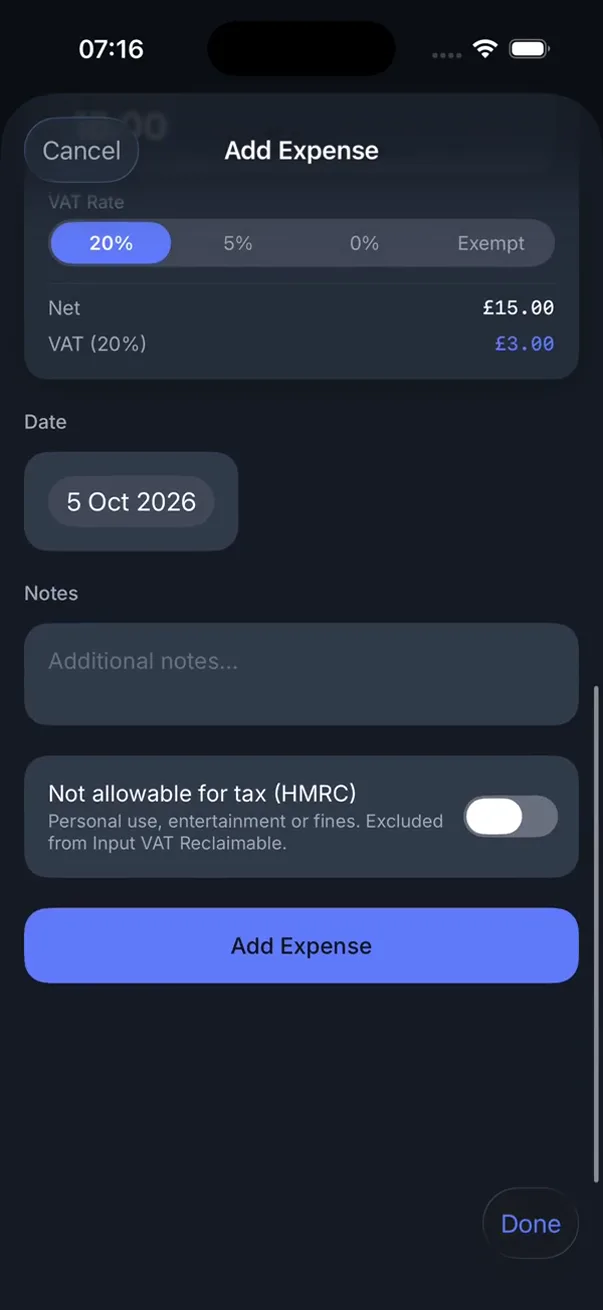
Whichever way you claim, HMRC expects records: business mileage if you use the flat rate, receipts and a private use split if you claim actual costs. Traddie keeps your business mileage and reads receipts into expenses when you photograph them, ready to export to your accounts.
Common questions
Do sole traders pay tax on their van?
Not as a benefit in kind. A sole trader claims the van as a business cost instead, through capital allowances on the purchase plus running costs, or through the simplified mileage rate. Either way, private use has to be taken out of the claim.
How much is van benefit in kind for 2026/27?
The flat van benefit charge is £4,170 for 2026/27, and the van fuel benefit charge is £798 if the employer pays for private fuel. The employee pays income tax on those amounts at their rate, and the company pays Class 1A National Insurance.
Does commuting count as private use of a company van?
No. Ordinary commuting between home and work is allowed in a company van without triggering the van benefit charge, and so is insignificant private use. Using it for the weekly shop or a holiday does trigger it.
Is there tax on an electric company van?
Fully electric vans have a nil van benefit charge, and there is no fuel benefit charge on electricity.
Can I claim the VAT back on a van?
If you are VAT registered and the van is used for your business, you can usually reclaim the VAT on the purchase. If there is more than incidental private use, the VAT has to be apportioned. Flat Rate Scheme users can only reclaim VAT on capital assets over £2,000.