What certificates does a landlord need? A 2026 checklist
Every safety certificate a UK landlord needs in 2026: gas safety record, EICR, EPC, smoke and CO alarms, legionella and PAT, with how often and who can do each.
By Kian McKiernan, founder of Traddie. Sources linked throughout; see also our editorial policy.
The landlord certificate checklist
This guide covers England, with the main differences in Scotland and Wales. Rules change, so check the current position for your property.
- Gas safety record: every 12 months, if there are gas appliances.
- EICR: at least every 5 years.
- EPC: valid for 10 years, minimum band E.
- Smoke alarms and carbon monoxide alarms: fitted, and checked at the start of each tenancy.
- Legionella risk assessment: no certificate, but you must assess and control the risk.
- PAT testing: required in Scotland for landlord supplied appliances; good practice elsewhere.
- HMOs: extra fire safety, often including fire alarm and emergency lighting certificates under the licence.
Gas safety record
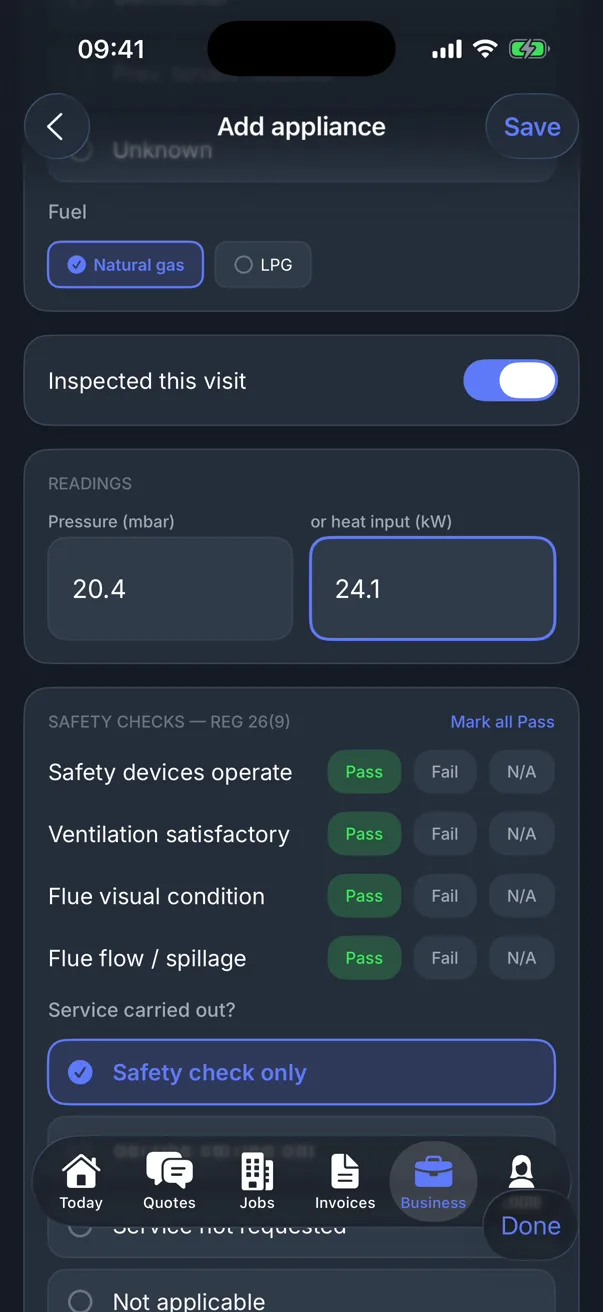
If the property has any gas appliances the landlord provides, each appliance and flue must be checked by a Gas Safe registered engineer at least every 12 months under regulation 36 of the Gas Safety (Installation and Use) Regulations 1998. Tenants get a copy within 28 days of the check, new tenants before they move in, and the landlord keeps each record until there have been two more checks.
A check done in the 2 months before the deadline counts as done on the deadline, so booking it early doesn't move the renewal date forward. Our guide to filling in a gas safety record explains what goes on it.
Electrical Installation Condition Report (EICR)
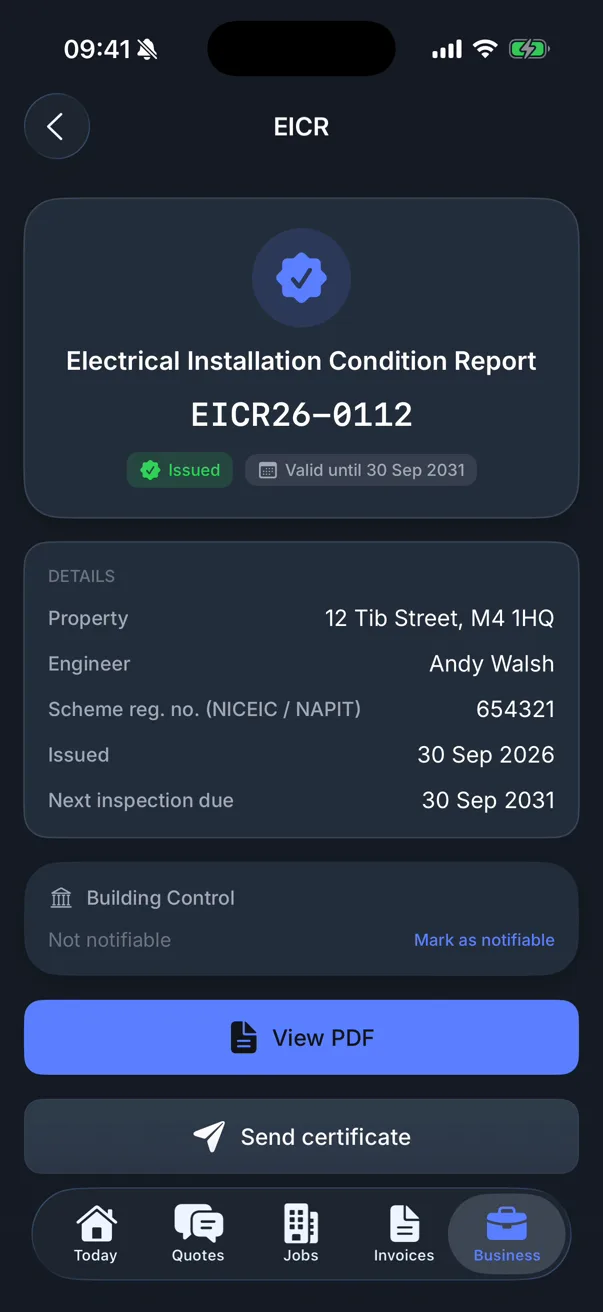
In England, private and social landlords must have the electrical installation inspected and tested at least every 5 years by a qualified and competent person, and before a new tenancy starts. Tenants get a copy within 28 days, and any remedial work or further investigation must be done within 28 days, or sooner if the report says so. Scotland and Wales also require an EICR at least every 5 years.
Read EICR codes explained to understand what a report means for you, and note that from 15 October 2026 EICRs are carried out to BS 7671 Amendment 4.
Energy Performance Certificate (EPC)
A rental home needs a valid EPC, which lasts 10 years, and tenants must be given a copy. Under the minimum energy efficiency standard, privately rented homes in England and Wales must be rated at least E, unless an exemption is registered.
The bar is going up. The government has confirmed private rented homes must reach EPC C by 1 October 2030, with a cap of £10,000 on what a landlord must spend per property. Homes rated C or above before 1 October 2029 will count as compliant.
Smoke and carbon monoxide alarms
In England, the regulations require at least one smoke alarm on every storey with living accommodation, and a carbon monoxide alarm in any room used as living accommodation that has a fixed combustion appliance, other than a gas cooker. Alarms must be working on the day the tenancy starts, and repaired or replaced when a tenant reports a fault. Councils can fine landlords up to £5,000.
Scotland is stricter. Every home must have interlinked ceiling mounted smoke alarms in the living room and every hallway and landing, a heat alarm in the kitchen, and a carbon monoxide detector wherever there is a carbon fuelled appliance such as a boiler or wood burner.
Legionella risk assessment
There is no such thing as a legionella certificate. HSE says landlords must assess the risk of legionella and control it, but most can do a simple assessment themselves, and written records aren't a legal requirement for most landlords. For a typical home, keeping hot water hot, cold water cold and water moving, and flushing the system before a new let, is usually enough. Be wary of anyone selling a legionella "certificate" as a legal must.
PAT testing
In Scotland, the Repairing Standard guidance requires private landlords to have appliances they supply PAT tested at least every 5 years, alongside the EICR. In England and Wales there is no specific PAT testing law for landlords, but appliances they supply must be safe, and a PAT record is the easiest way to show it. Our PAT testing guide has the detail.
HMOs and extra fire safety
Houses in multiple occupation usually need a licence, and licence conditions commonly add fire safety requirements, such as a fire alarm system and emergency lighting, each with its own certificate and testing schedule. Check your council's licence conditions, because they vary.
Keeping track of renewal dates
The hard part isn't getting the certificates, it is remembering when each one runs out across every property. Letting agents and landlords with more than a few homes need one place that shows what is due.
For trades who do this work, that is an opportunity. In Traddie, every gas safety record, EICR and PAT certificate you issue is stored against the property with its renewal date, landlords and agents can see every certificate for a property in your customer portal, and Traddie reminds you and, if you choose, the customer before each one is due. The repeat job comes back to you.
Common questions
What certificates does a landlord legally need?
In England, a gas safety record every 12 months if there are gas appliances, an EICR at least every 5 years, and an EPC of at least band E. Landlords must also fit smoke and carbon monoxide alarms where required. Scotland and Wales have similar rules with some differences, including PAT testing in Scotland.
How often does a landlord need a gas safety certificate?
Every 12 months. A check done in the 2 months before the deadline counts as done on the deadline, so the renewal date stays the same.
How often does a landlord need an EICR?
At least every 5 years, or sooner if the last report recommends it, and before a new tenancy starts in England.
Do landlords need a legionella certificate?
No. There is no legionella certificate. Landlords must assess the risk, which most can do themselves, and control it. Written records aren't a legal requirement for most landlords, but they are sensible.
Do landlords need PAT testing?
In Scotland, yes, for appliances the landlord supplies. In England and Wales it isn't a specific legal requirement, but landlords must make sure appliances they provide are safe, and testing is a common way to show it.
What EPC rating does a rental property need?
At least E in England and Wales, unless an exemption is registered. The government has confirmed private rented homes must reach EPC C by 1 October 2030.
Sources
- Gas Safety (Installation and Use) Regulations 1998, regulation 36
- The Electrical Safety Standards in the Private Rented Sector (England) Regulations 2020, regulation 3
- GOV.UK, domestic private rented property: minimum energy efficiency standard
- GOV.UK, improving the energy performance of privately rented homes: government response
- GOV.UK, Smoke and Carbon Monoxide Alarm (Amendment) Regulations 2022: guidance
- HSE, legionella and landlords' responsibilities
- Scottish Government, fire and smoke alarms: the law
- Scottish Government, Repairing Standard statutory guidance, Annex D3