How to chase unpaid invoices: a UK guide for trades, with templates
How to chase an unpaid invoice step by step: when to send each reminder, what to say, the late payment rules for business customers, and how to automate it.
By Kian McKiernan, founder of Traddie. Sources linked throughout; see also our editorial policy.
Why chasing matters more than you think
Late payment is the most expensive admin problem a small trade has. Hiscox's Late Payments Report found small businesses are owed £12,357 a year on average in late payments, chase 14 late payments a year, and wait around three weeks past the due date for each one.
Most late payers aren't dodging you. They forgot, the invoice went to the wrong inbox, or it is sitting behind something more urgent. The aim of chasing is to make paying you the easiest thing on their list, without spoiling a relationship you might want again.
Before you chase: make the invoice easy to pay
The best chase is the one you never have to send. Put the due date in the invoice in plain words, show your bank details, and add a link so the customer can pay by card in a few taps. Send it the day the job is finished, while the work is fresh in their mind, and agree payment terms before the job starts, not after.
The chasing schedule that works
Use the channel the customer actually reads. Email leaves a record; a text or WhatsApp gets read faster. A phone call is worth it before the final notice, especially for a big invoice.
- On the due date: a friendly reminder. Assume they forgot.
- 7 days late: a clearer reminder, with the amount, the invoice number and the link to pay.
- 14 days late: a firm reminder. Say when you need it paid by.
- 28 days late: a final notice. Say what you will do next if it isn't paid.
- After that: a letter before action, then a court claim if you need to.
Template 1: friendly reminder, on the due date
Hi Sarah, just a quick reminder that invoice INV-0041 for £924.00 for the boiler replacement is due today. You can pay by card here: [link]. Thanks again for the work, Dave.
Template 2: clearer reminder, 7 days late
Hi Sarah, invoice INV-0041 for £924.00 was due on 2 October and is now a week overdue. If it has already been paid, thank you and please ignore this. If not, you can pay by card here: [link], or by bank transfer to the details on the invoice. Thanks, Dave.
Template 3: firm reminder, 14 days late
Hi Sarah, invoice INV-0041 for £924.00 is now two weeks overdue. Please can you pay it by Friday 23 October. If there is a problem with the work or the invoice, let me know today so I can sort it. Pay by card here: [link]. Dave.
Template 4: final notice, 28 days late
Dear Sarah, despite my reminders, invoice INV-0041 for £924.00 remains unpaid and is now 28 days overdue. Please pay the full amount by 6 November. If it is not paid by then, I will send a formal letter before action and may start a court claim to recover the debt and my costs. Pay by card here: [link]. Regards, Dave Hughes, Hughes Heating Ltd.
For a business customer, you can add that statutory interest and compensation are being added under the Late Payment of Commercial Debts (Interest) Act 1998.
Charging interest and compensation
If your customer is a business, the law gives you two extras. GOV.UK explains you can claim statutory interest at 8% a year above the Bank of England base rate, and a fixed sum of £40 for a debt under £1,000, £70 for £1,000 to £9,999.99, and £100 for £10,000 or more, per invoice. Homeowners are not covered, unless you agreed late payment terms with them in writing before the work.
Our guide to charging interest on late invoices explains how, and the late payment interest calculator works out the figure for you.
When reminders don't work: letter before action and court
Before you start a court claim, send a letter before action. It sets out what is owed, why, and the deadline to pay: usually 14 days for a business and 30 days for an individual. Many customers pay at this point, because it is the first time it looks serious. Our late payment letter template gives you the wording.
If they still don't pay, you can make a court claim for money. Most trade debts are small enough for the small claims track, and you can claim online. Keep every reminder, the invoice, the quote they accepted and any photos of the finished work: that is your evidence.
How to chase overdue invoices automatically
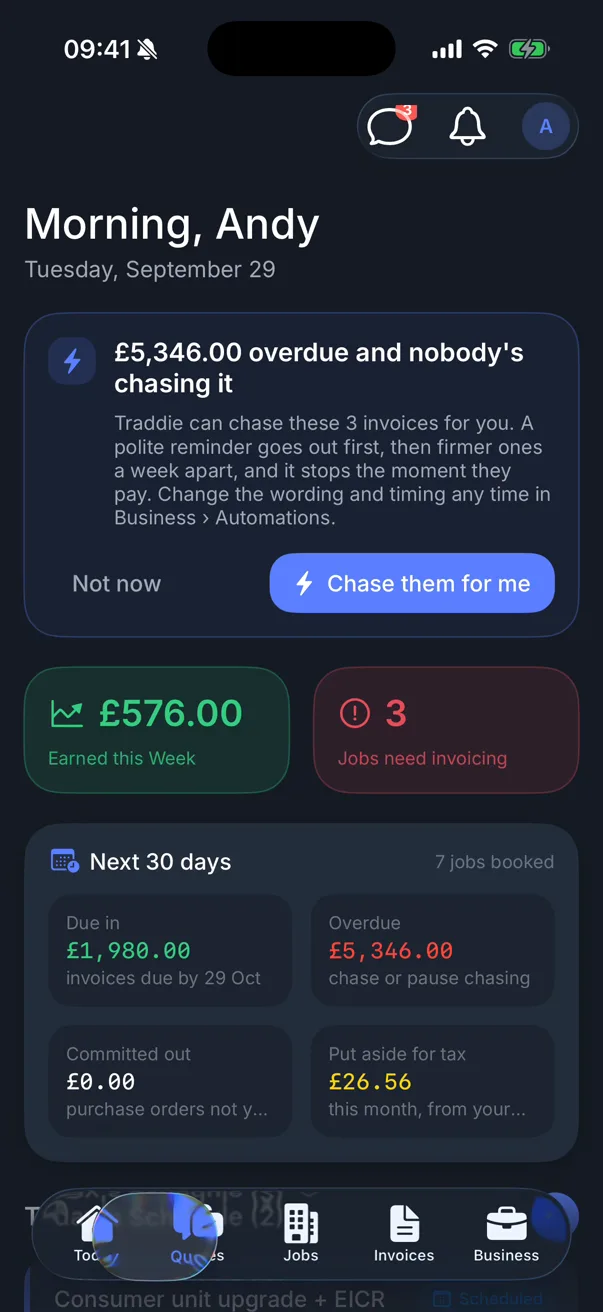
Sending four reminders to every late payer is exactly the sort of job that slips at nine in the evening. Software can do it for you. Traddie chases overdue invoices automatically: polite reminders go out in your business name on a schedule that starts gentle and gets firmer, each with a card payment link, and they stop the moment the invoice is paid. You can also send a ready written text or WhatsApp nudge in one tap.
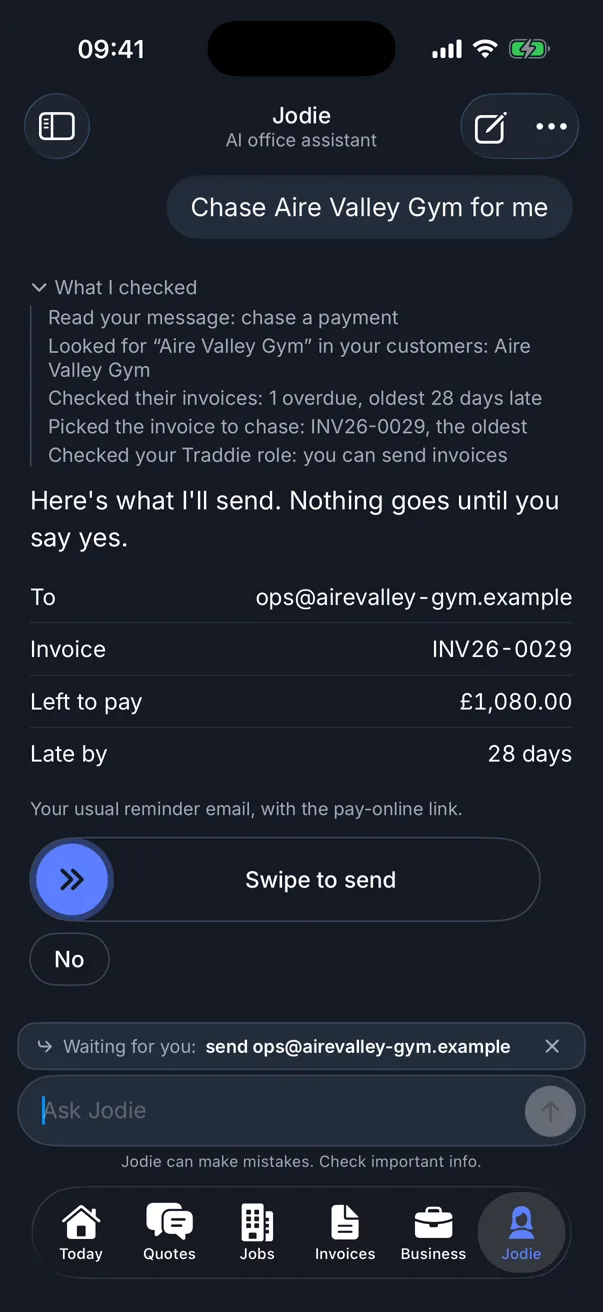
If you want to do it by message instead, Jodie, the AI agent in Traddie, will find every overdue invoice and prepare a reminder for each one to send when you say yes. See Meet Jodie for how that works.
Common questions
How soon should I chase an unpaid invoice?
Send a friendly reminder on the due date, or a day or two after. Most late invoices are forgotten rather than disputed, so an early, polite nudge with a link to pay gets most of them settled.
How many reminders should I send?
Three or four is usual: a friendly reminder, a clearer follow up after a week, a firm reminder at two weeks, and a final notice before you take further action.
Can I charge interest on a late invoice?
For business customers, yes. The Late Payment of Commercial Debts (Interest) Act 1998 lets you claim 8% a year above the Bank of England base rate, plus fixed compensation of £40, £70 or £100 per invoice. For homeowners, only if you agreed late payment terms with them in writing before the work.
Can I chase invoices automatically?
Yes. Invoicing software such as Traddie can send polite reminders in your business name on a schedule, with a card payment link in each one, and stop as soon as the customer pays.
What do I do if a customer still won't pay?
Send a letter before action with a clear deadline. If they still don't pay, you can make a claim through the courts, which for most trade debts means the small claims track and the online Money Claim service.