How to do an EICR: a step by step guide for electricians (BS 7671 A4:2026)
How to carry out an EICR step by step: extent and limitations, inspection, dead and live tests, C1 to FI codes, the Amendment 4 changes from 15 October 2026.
By Kian McKiernan, founder of Traddie. Sources linked throughout; see also our editorial policy.
What is an EICR?
An EICR, or Electrical Installation Condition Report, is a formal report on the condition of an existing electrical installation. It is the result of a periodic inspection and test: the inspector checks the installation against the current edition of BS 7671, records anything that has deteriorated, been damaged or doesn't meet the standard, gives each observation a classification code and says whether the installation is satisfactory for continued use.
It is not a certificate for new work. New circuits and installations get an Electrical Installation Certificate, and small additions or alterations get a Minor Electrical Installation Works Certificate. An EICR is about what is already there.
What changes on 15 October 2026: Amendment 4
The IET and BSI published BS 7671:2018+A4:2026 on 15 April 2026. The previous edition, BS 7671:2018+A2:2022+A3:2024, is withdrawn on 15 October 2026. Between those dates both are current. After it, NICEIC says EICRs must be carried out to Amendment 4. These are the changes that matter most when you fill in a report.
- FI no longer makes an installation unsatisfactory. Only C1 and C2 do. FI now reads "further investigation is advised" and the words "without delay" have gone.
- Observations are split on the report into C1 and C2, which affect the overall outcome, and C3 and FI, which don't.
- TN-C-S earthing is split into PME and PNB on the model forms, the first time PNB has appeared in BS 7671.
- The forms carry the new edition reference, and the declaration should state which edition the work was done to.
- The inspection schedule records whether AFDDs are fitted and working.
- A new chapter covers battery energy storage systems, which you will now inspect against.
Does Amendment 4 make old EICRs invalid?
No. A report done to the previous edition stays valid until its recommended next inspection date. And an older installation doesn't automatically fail because the standard has moved on. The question an EICR answers is still whether the installation is safe for continued use, not whether it would be installed the same way today. Work designed before 15 October 2026 can also be completed to the previous edition, but tell your client if that applies.
Who can carry out an EICR?
An EICR must be carried out by a skilled person who is competent in inspection and testing: someone with the right qualifications, experience and test equipment, and the knowledge to judge what they find. In practice, landlords, letting agents and insurers usually look for an electrician registered with a scheme such as NICEIC or NAPIT, and the government's landlord guidance says the person should be qualified and competent.
When is an EICR needed?
For rented homes it is a legal requirement. In England, the Electrical Safety Standards regulations cover private landlords and, since the 2025 amendment, social landlords too. The landlord must:
- Have the installation inspected and tested at least every 5 years, or sooner if the last report says so, and before a new specified tenancy starts.
- Give each existing tenant a copy within 28 days of the inspection.
- Give a new tenant a copy before they move in, and a prospective tenant a copy within 28 days of asking in writing.
- Give the local council a copy within 7 days of a written request.
- Have remedial or further investigative work done within 28 days, or sooner if the report says so, and send written confirmation to the tenant and council within 28 days of it being finished.
Scotland, Wales and owner occupied homes
In Scotland, the Repairing Standard statutory guidance says landlords need an EICR at least every 5 years, along with PAT testing of appliances they provide, and tenants get copies of both reports. In Wales, under the Renting Homes fitness rules, the Welsh Government says a report is valid for up to 5 years and the tenant must get a copy within 14 days.
Owner occupiers have no legal duty, but Electrical Safety First recommends an inspection at least every 10 years and when you move into a property. Businesses use EICRs to show they are maintaining their installation, and insurers and mortgage lenders often ask for one.
Step 1: Agree the extent and limitations
Before you test anything, agree with the person ordering the report what is in scope. Which parts of the installation will you inspect, what percentage of accessories and circuits will you sample, and what won't you be able to get to: under floors, behind fixed furniture, in a locked outbuilding. Write it on the report.
This is the step most likely to cause an argument later if it is skipped. A clear extent and limitations section protects you and tells the next inspector exactly what was and wasn't looked at.
Step 2: Gather the information
Ask for the previous EICR or EIC, any circuit charts and any drawings. Check the label in the consumer unit for the date of the last inspection. Find out how the property is used, how old the installation is, and whether there have been alterations since the last report.
At the origin, identify the supply characteristics and the earthing arrangement. With Amendment 4, that means recording whether a TN-C-S supply is PME or PNB. If you can't tell, NICEIC notes the network operator should tell you the earthing type free of charge.
Step 3: Isolate safely
Every dead test starts with safe isolation. Follow a recognised procedure, such as Electrical Safety First's Best Practice Guide 2: identify the circuit, isolate it, secure the isolation, prove your voltage indicator on a known source, test for dead, and prove the indicator again. Use test leads and probes that meet HSE guidance GS38.
If the property is occupied, agree when the power can go off and make sure nothing critical, such as medical equipment or a freezer full of food, is on the circuits you are isolating.
Step 4: Carry out the visual inspection
Work through the schedule of inspections. Much of an EICR's value is in what you see before you put a tester on anything.
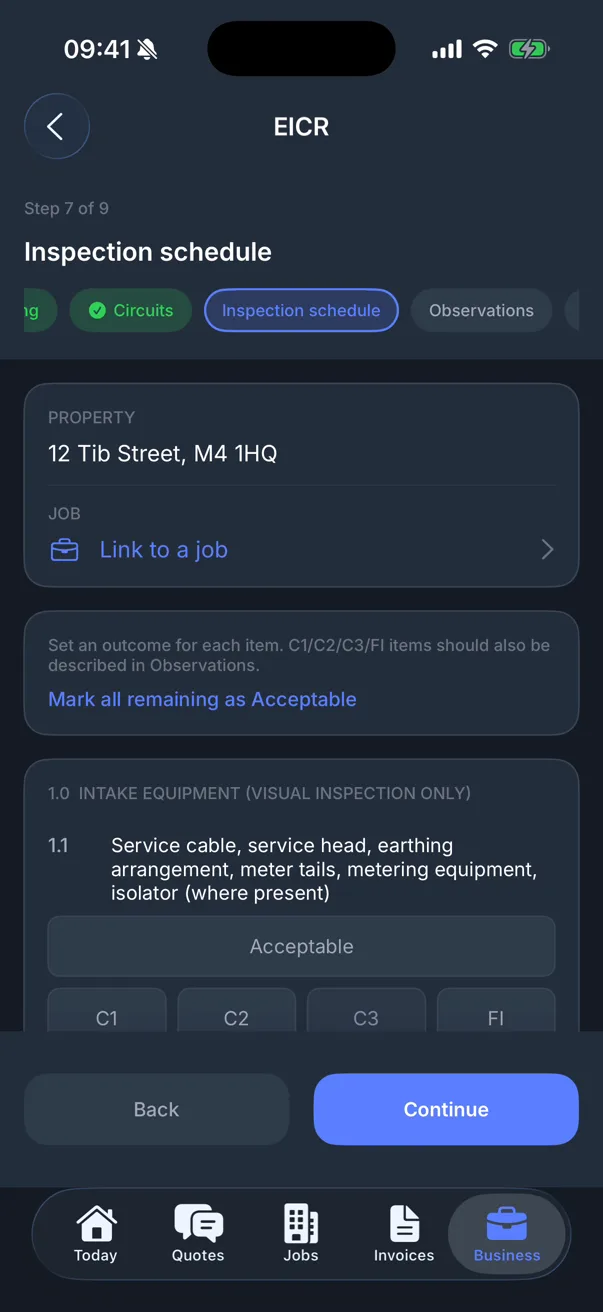
- Intake equipment: service head, meter tails, isolator and their condition.
- Earthing and bonding: the main earthing conductor, main protective bonding to gas and water, and sizes.
- The consumer unit: condition, enclosure, blanks fitted, labelling, signs of overheating, and suitability of the protective devices.
- RCD and AFDD protection where it is needed.
- Wiring systems: cable condition, support, damage, and suitability for the environment.
- Accessories: sockets, switches and fittings, sampled as agreed.
- Special locations such as bathrooms and outdoor circuits.
Step 5: Do the dead tests
With the circuit safely isolated, carry out the dead tests on the circuits in your sample.
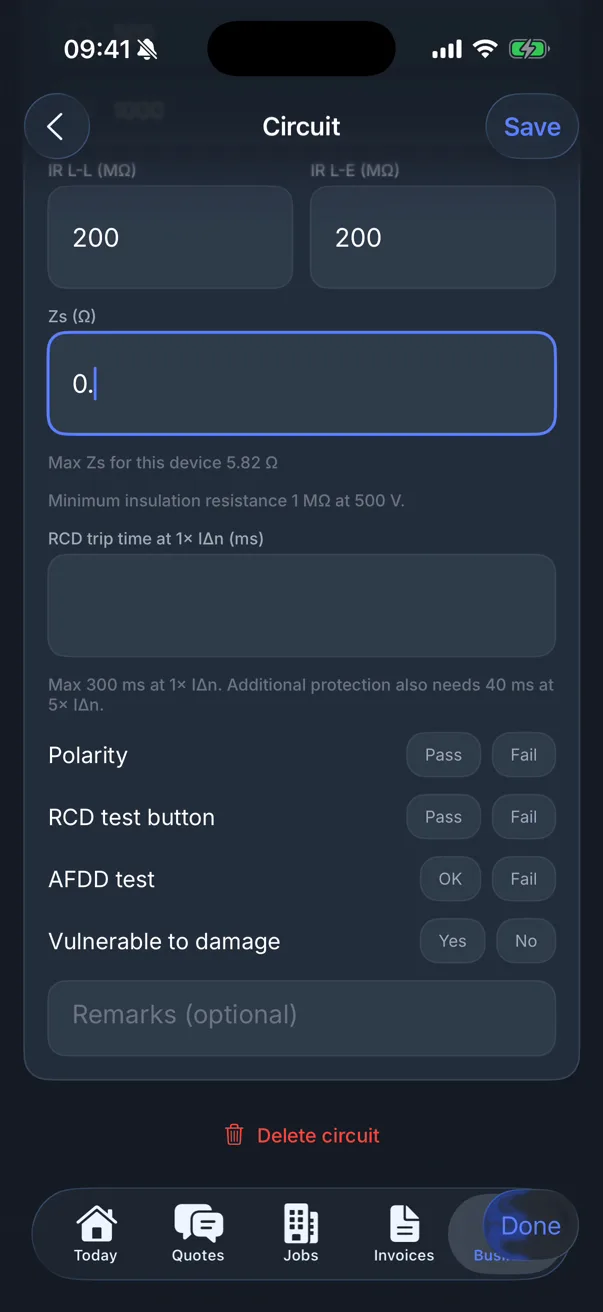
- Continuity of protective conductors: measure R1+R2 (or R2) on each circuit, and continuity of the main and supplementary bonding.
- Ring final circuit continuity: measure the end to end resistance of the line, neutral and protective conductors, then cross connect and check each socket to confirm it is a true ring.
- Insulation resistance: test between live conductors and between live conductors and earth. For circuits up to 500 V, BS 7671 requires a test at 500 V DC with a minimum of 1 MΩ. Disconnect or protect sensitive equipment first.
- Polarity: confirm single pole devices are in the line conductor and accessories are correctly connected.
Step 6: Do the live tests
With the supply restored, carry out the live tests.
- External earth fault loop impedance (Ze) at the origin, with the main earthing conductor disconnected and safely reconnected.
- Prospective fault current at the origin.
- Earth fault loop impedance (Zs) on each circuit, compared with the maximum for the protective device. Measured values are taken cold, so allow for conductors running hotter in use when you compare them.
- RCD operation: test each RCD at its rated residual current and record the trip time against the maximum, and check the test button works.
- Functional checks of switchgear, isolators and the test button on any AFDDs.
Step 7: Record and code the observations
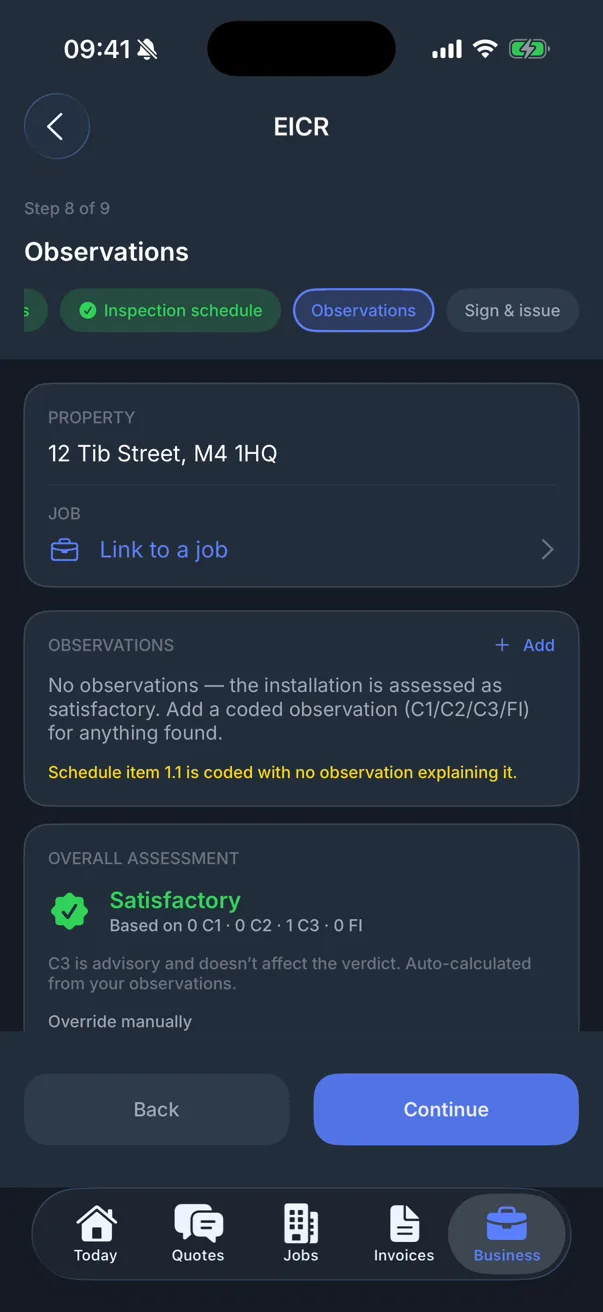
Write each observation clearly, say where it is, and give it one classification code. If more than one could apply, use the most serious. Electrical Safety First's Best Practice Guide 4 is the industry reference for coding consistently, with worked examples.
- C1, danger present: risk of injury, immediate remedial action required. For example, accessible live parts where a blank is missing from a consumer unit.
- C2, potentially dangerous: urgent remedial action required. For example, no reliable means of earthing, or an RCD that fails its test.
- C3, improvement recommended: not dangerous, but would improve safety. For example, no RCD protection on lighting circuits in a home.
- FI, further investigation advised: you can't tell from what you could access whether there is a problem.
Step 8: Make the overall assessment
If there is any C1 or C2, the installation is unsatisfactory. Under Amendment 4, C3 and FI observations do not make it unsatisfactory on their own, which is a change from Amendment 3, when FI did.
If you find a C1, make it safe before you leave, with the agreement of the person responsible, and make sure they understand the danger in writing.
Step 9: Recommend the next inspection
Set the next inspection date from what you found and how the installation is used. A rented home can be no more than 5 years. An owner occupied home in good condition may be longer, and an installation in poor condition, or in a harsh environment, should be sooner.
Step 10: Issue the report and give copies
Complete and sign the report, including the schedules of circuit details and test results, and give it to the person who ordered it. If they are a landlord, remind them of the 28 day duty to give tenants a copy and to finish any remedial work. Keep your own copy.
How long does an EICR take?
It depends on the size and age of the installation, the number of circuits and boards, the sampling you agreed and how easy it is to get to things. A small flat with one consumer unit is a very different job from a large house with outbuildings. The fastest saving is usually the paperwork, not the testing: our guide to the quickest way to do an EICR covers how to save time without cutting corners.
Doing your EICR on your phone with Traddie
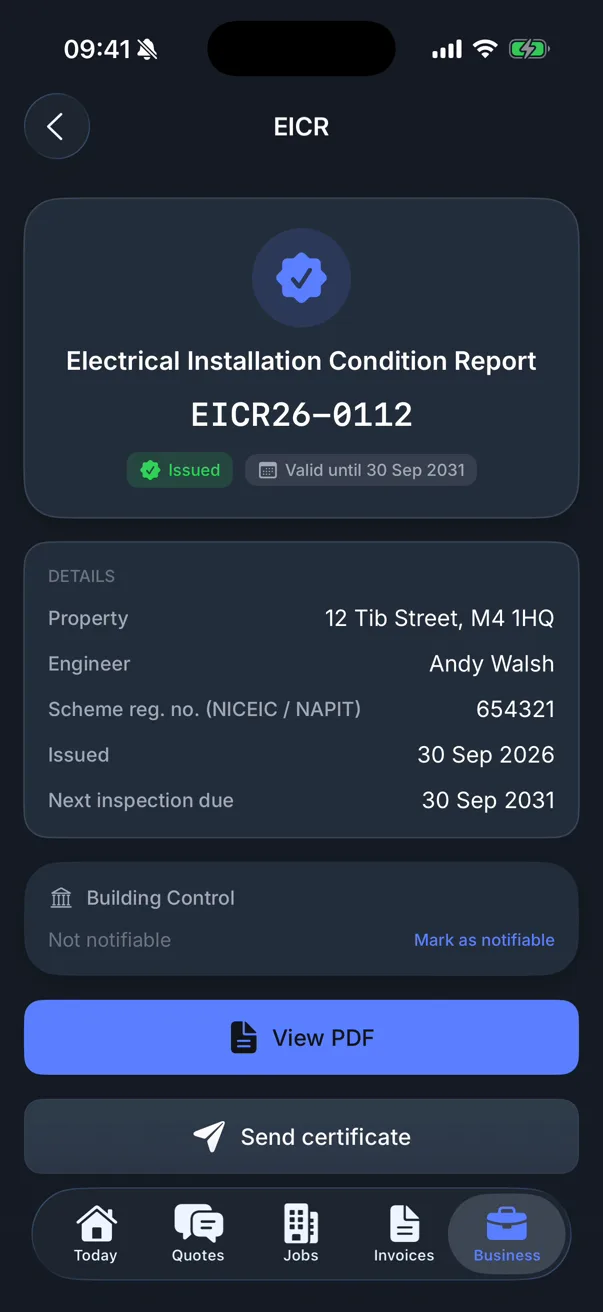
Traddie's EICR follows the BS 7671 model forms and the Amendment 4 changes, including the C1 and C2 split from C3 and FI. You fill it in on site in steps: supply and earthing, circuits, test results, the inspection schedule, observations, then sign and issue.
Photograph the consumer unit and Traddie reads the circuits into the schedule for you to check. As you type a reading, it shows the maximum Zs for that protective device and the minimum insulation resistance, so you can see a problem while you are still at the board. The overall assessment is worked out from your codes. The customer signs on your phone, and the PDF goes to them before you leave, with a renewal reminder set for the next inspection date.
Common questions
What is an EICR?
An Electrical Installation Condition Report is a formal report on the condition of an existing fixed electrical installation, carried out by a skilled and competent person against BS 7671. It lists any defects with a classification code and says whether the installation is satisfactory for continued use.
What changes to EICRs on 15 October 2026?
BS 7671:2018+A2:2022+A3:2024 is withdrawn on 15 October 2026 and EICRs must be carried out to BS 7671:2018+A4:2026. The biggest change on the report is that FI no longer makes an installation unsatisfactory: only C1 and C2 do. The model forms also change, including separate earthing options for TN-C-S PME and PNB.
Does an old EICR become invalid when Amendment 4 comes in?
No. A report done to the previous edition stays valid until its recommended next inspection date. An older installation does not fail just because the standard changed: the inspector still assesses whether it is safe for continued use.
How often does a landlord need an EICR?
In England, Wales and Scotland the maximum is 5 years, or sooner if the last report recommends it. In England, landlords must also give tenants a copy within 28 days of the inspection and provide it to new tenants before they move in.
What makes an EICR unsatisfactory?
Any C1 (danger present) or C2 (potentially dangerous) observation makes the overall condition unsatisfactory. Under Amendment 4, C3 (improvement recommended) and FI (further investigation advised) do not.
Can I do an EICR on my phone?
Yes. Apps such as Traddie let you fill in the whole EICR on site, including the circuit schedule, test results, inspection schedule and observations, collect signatures on screen and send the PDF before you leave.
Sources
- IET, IET and BSI officially publish Amendment 4 (2026) to BS 7671:2018, 15 April 2026
- NICEIC, understanding BS 7671:2018+Amendment 4:2026
- Electrical Safety First, Best Practice Guides (including Guide 4, condition reporting, and Guide 2, safe isolation)
- The Electrical Safety Standards in the Private Rented Sector (England) Regulations 2020, regulation 3
- Scottish Government, Repairing Standard statutory guidance, Annex D3
- Welsh Government, fitness of homes for human habitation: guidance for landlords
- Electrical Safety First, how often owner occupiers should have the electrics checked
- HSE, GS38 electrical test equipment for use on low voltage systems