PAT testing explained: how to do it, how often, and how to record it
PAT testing explained for UK trades: whether it is a legal requirement, how often to test, the visual inspection and tests, and how to record the results.
By Kian McKiernan, founder of Traddie. Sources linked throughout; see also our editorial policy.
What is PAT testing?
PAT testing, or portable appliance testing, is the routine inspection and testing of electrical equipment that plugs in: kettles, extension leads, power tools, computers, heaters. The industry term now is in-service inspection and testing of electrical equipment, which is the name of the IET Code of Practice most testers follow.
Most faults are found by looking, not by testing. HSE says the bulk of problems can be spotted by a simple visual check, and that testing adds value for equipment that is used regularly and moved a lot.
Is PAT testing a legal requirement?
Not on its own. The Electricity at Work Regulations 1989 require that electrical equipment which could cause danger is maintained so far as reasonably practicable to prevent that danger. HSE is clear that the law doesn't say what needs to be done, by whom or how often, and that it doesn't require you to label equipment or keep records.
For low risk workplaces such as offices and shops, HSE's own leaflet calls the idea that everything needs a yearly PAT test a myth. A risk based approach is what the law expects.
The main exception for trades is lettings in Scotland. The Repairing Standard statutory guidance requires private landlords to have appliances they provide PAT tested, at least every 5 years, with a PAT report alongside the EICR. Insurers and contracts can also require testing, so check what applies to the job.
How often should equipment be tested?
There is no single answer, and the old one has gone. The 4th edition of the IET Code of Practice had a table of suggested intervals. The 5th edition removed it and didn't replace it. Intervals now come from a risk assessment by the duty holder.
The things that push an interval shorter are obvious enough to anyone who has worked on site: equipment used hard, moved a lot, used outdoors or in wet or dusty conditions, or used by people who won't spot or report damage. A 110 V drill on a building site and a monitor on a desk are at opposite ends.
The three levels: user checks, visual inspection and testing
HSE's guidance describes maintenance as three things working together.
- User checks: the person using the equipment looks for obvious damage before they use it, and stops using it if something is wrong.
- Formal visual inspection: a competent person unplugs it and inspects the plug, the fuse, the cable, the cable grip and the casing, and records the result.
- Combined inspection and testing: the formal visual inspection plus electrical tests with a PAT tester, by someone with the right equipment and the knowledge to understand the results.
Class I and Class II equipment
What you test depends on how the appliance is protected. Class I equipment has exposed metal parts and relies on an earth connection, so you test the earth. Class II equipment is double insulated, marked with the square in a square symbol, and has no earth to test. Class III equipment runs from a safety extra low voltage supply.
How to do a PAT test, step by step
These are the usual steps for a combined inspection and test. Follow your tester's instructions and the IET Code of Practice for the detail.
- Identify the equipment and its class, and give it a unique number if it doesn't have one.
- Formal visual inspection: unplug it, check the plug for damage and overheating, check the fuse is the right rating, check the cable and cable grip, and check the casing.
- Earth continuity (Class I): measure the resistance from the plug earth pin to exposed metalwork. A commonly used limit is 0.1 Ω plus the resistance of the cable.
- Insulation resistance: test between the live conductors and earth or accessible parts, usually at 500 V DC. Commonly used minimums are 1 MΩ for Class I and 2 MΩ for Class II. Where a 500 V test could damage the equipment or would trip it, use a protective conductor current or touch current test instead.
- Polarity: check extension leads and detachable cords are wired correctly.
- Functional check: switch it on and make sure it works as it should.
- Record the result, and label it if labels are part of the system.
Recording PAT results
The law doesn't require records, but HSE notes they are a useful way to manage maintenance and spot equipment that keeps failing. For a landlord or a business, a clear PAT certificate with an appliance register is also what they will be asked for by an insurer or a letting agent.
A good record lists each appliance, its location and class, the visual inspection result, the test readings, pass or fail, the date and who did it, and when it should next be looked at.
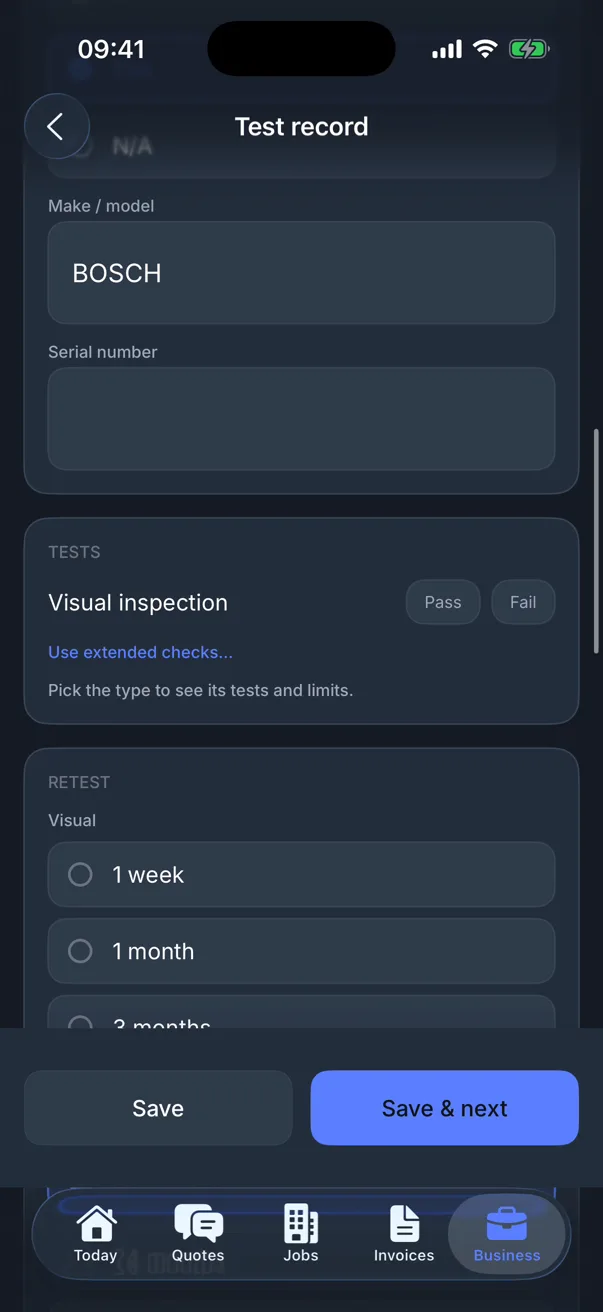
The quickest way to do PAT testing
The testing is quick. The time goes on writing down every appliance and typing the results up later. Fill the register in on your phone as you go, keep the appliance list for next time so a repeat visit is a matter of retesting rather than relisting, and send the certificate before you leave.
Traddie does this. Record each appliance and its results on your phone, issue a PAT certificate with the full appliance register, and send it to the customer from the property. It is stored against the property for next time, with a reminder when it is due, alongside your EICRs and gas safety records.
Common questions
Is PAT testing a legal requirement?
Not in itself. The law requires electrical equipment that could cause danger to be maintained, but it does not say how or how often. PAT testing is one way of showing you have maintained it. Private landlords in Scotland are the main exception: their statutory guidance requires PAT testing of appliances they supply.
How often should PAT testing be done?
There is no fixed interval. The IET Code of Practice 5th edition says intervals should come from a risk assessment that looks at the type of equipment, how it is used, where and by whom. Equipment used hard on building sites needs checking far more often than a printer in an office.
Do landlords need PAT testing?
In Scotland, yes: the Repairing Standard guidance requires PAT testing of landlord supplied appliances at least every 5 years. In England and Wales there is no specific PAT duty for private landlords, but they must make sure appliances they provide are safe, and testing is a common way to show that.
What is the difference between Class I and Class II?
Class I appliances rely on an earth connection for protection and have exposed metal parts, such as a kettle or a toaster. Class II appliances are double insulated, carry the square in a square symbol and don't need an earth, such as many power tools and hairdryers.
Do I need to label tested equipment?
There is no legal requirement to label equipment or keep records, but labels and a simple register make it easy to see what has been checked and when.
Sources
- HSE, PAT: answers to popular questions
- HSE, maintaining portable electric equipment in low risk environments (INDG236)
- HSE, maintaining portable electrical equipment (HSG107)
- IET Wiring Matters, the 5th edition of the Code of Practice for In-service Inspection and Testing of Electrical Equipment
- Scottish Government, Repairing Standard statutory guidance, Annex D3