How to work out job profit (and why most trades get it wrong)
How to work out the real profit on a trade job: what to include, margin vs markup, a worked example, what a good margin looks like, and how to track it.
By Kian McKiernan, founder of Traddie. Sources linked throughout; see also our editorial policy.
Why job profit is the number that matters
Turnover tells you how busy you were. Profit on each job tells you whether being busy was worth it. Plenty of trades have a full diary and a thin bank balance because a handful of jobs quietly lost money: a second visit nobody charged for, an extra day, a skip that wasn't in the quote.
Working out the profit on each job, not just the year, is how you find out which work to chase and which to price up or turn down.
The formula
Job profit = price excluding VAT − materials − labour − subcontractors − other direct costs.
Margin = job profit ÷ price excluding VAT × 100.
Leave VAT out completely. If you are VAT registered, the VAT you charge belongs to HMRC and the VAT you pay on materials comes back to you, so working in net figures keeps it honest. If you only have a VAT inclusive figure, the remove VAT calculator takes it off for you.
What to include
Count everything the job needed, at what it really cost you.
- Materials at what you actually paid, including returns you didn't get round to and the second trip for a fitting.
- Labour: every day on the job, including your own, at what it really costs. For employees, that is wages plus employer National Insurance and pension.
- Subcontractors.
- Plant and tool hire, skips and waste.
- Parking, congestion charges and tolls.
- Certificates, notifications and anything else the job needed.
- Travel time, if the job is far enough away to eat into a day.
A worked example
A bathroom refit quoted at £6,000 excluding VAT. It took 6 days for you and an apprentice.
- Materials: £2,150.
- Your time: 6 days at a £250 day rate = £1,500.
- Apprentice: 6 days at £110 a day all in = £660.
- Skip and tip runs: £320.
- Plumbing fittings second trip, parking and sundries: £120.
- Total cost: £4,750.
- Job profit: £6,000 − £4,750 = £1,250.
- Margin: £1,250 ÷ £6,000 = 20.8%.
Your effective day rate
Here is a second way to look at the same job. Take the price, less materials and other costs (but not your own time), and divide by your days on it. On the bathroom: £6,000 − £2,150 − £660 − £320 − £120 = £2,750, over 6 days = £458 a day.
If the same job had run to 8 days, with the apprentice there too, it would be £6,000 − £2,150 − £880 − £320 − £120 = £2,530 over 8 days, or £316 a day. That is the number that shows you, in plain pounds, what an overrun cost you.
Margin vs markup: the mistake that costs the most
Markup is profit as a percentage of cost. Margin is profit as a percentage of price. They are not the same, and mixing them up is one of the commonest ways trades undercharge. If you want a 25% margin and you add 25% to your costs, you only get a 20% margin. To get a 25% margin, divide your costs by 0.75 instead. The markup and margin calculator does the conversion.
What is a good margin?
Most trade businesses aim for a gross margin of 20% to 40% once materials and direct labour are out. Materials heavy work, such as a kitchen supply and fit, sits at the lower end because you are carrying more cost. Labour heavy work, such as fault finding or decorating, should sit higher, because there is nothing to absorb a bad day. Your overheads, the van, insurance, phone, software and accountant, have to come out of that gross profit before you see a penny.
Tracking profit job by job
Working it out on a calculator after the job is better than never. The job profit calculator does it in a minute. Doing it automatically is better still.
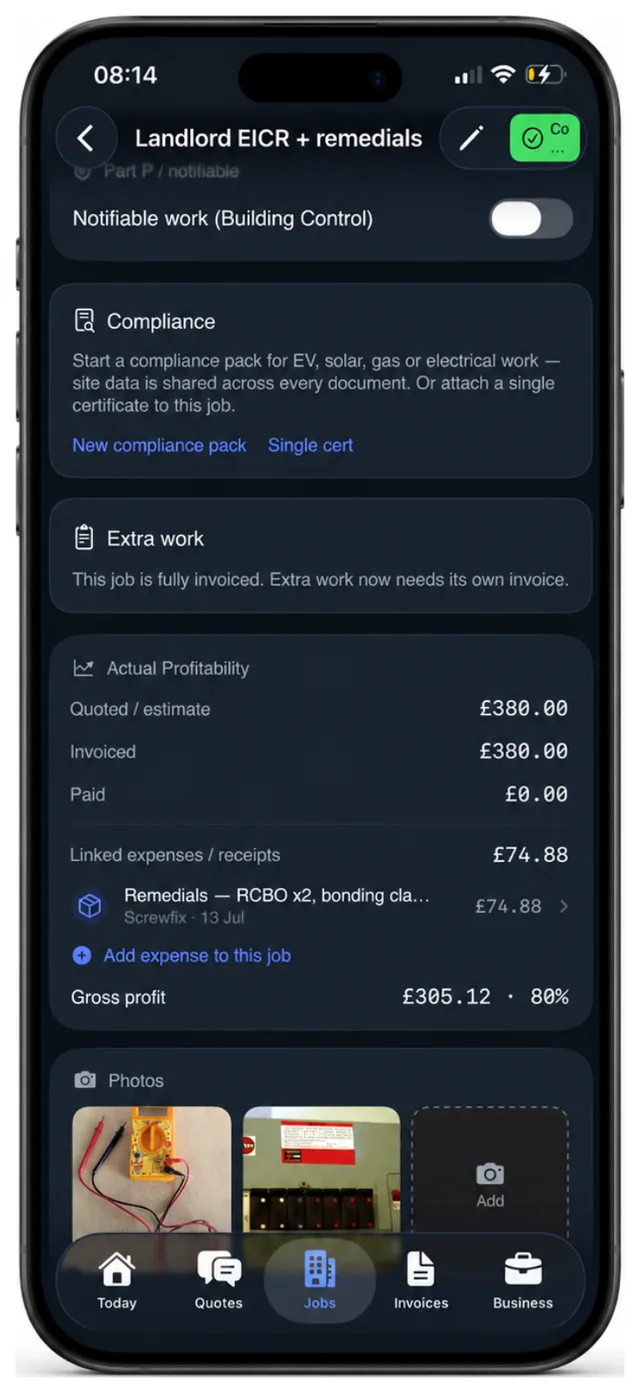
In Traddie, every job shows its actual profitability: what you quoted, invoiced and were paid, against the receipts and expenses linked to it and the hours worked, with the profit and margin worked out as you go. Photograph a receipt and it lands on the right job, so the number is right without a shoebox at the end of the month.
Common questions
How do I work out the profit on a job?
Take the price excluding VAT and subtract materials at cost, labour including your own time, subcontractors and other direct costs such as skips and plant. What is left is the gross profit. Divide it by the price to get the margin.
What is a good profit margin for a trade job?
Most trade businesses aim for a gross margin of 20% to 40% once materials and direct labour are out. Materials heavy jobs sit lower, labour heavy jobs should sit higher.
What is the difference between markup and margin?
Markup is profit as a percentage of cost. Margin is profit as a percentage of the price. Adding 25% to a £100 cost gives £125, which is a 25% markup but a 20% margin.
Should I include my own time in job costs?
Yes. If you don't, every job looks profitable. Cost your own day at your target day rate, then the profit tells you whether the job paid you well on top of paying you at all.