BS 7671 Amendment 4: what changes on 15 October 2026
BS 7671:2018+A4:2026 replaces the A3 edition on 15 October 2026. What changes for EICRs, certificates, PNB earthing, batteries and AFDDs, in plain English.
By Kian McKiernan, founder of Traddie. Sources linked throughout; see also our editorial policy.
The dates that matter
The IET and BSI published BS 7671:2018+A4:2026 on 15 April 2026. For six months both it and the previous edition, BS 7671:2018+A2:2022+A3:2024 (the brown book), have been current. On 15 October 2026 the previous edition is withdrawn.
In practice that means three things. Work designed from 15 October should be to Amendment 4. EICRs carried out from 15 October should be to Amendment 4. And work that was designed before 15 October can still be completed to the previous edition after it, as long as you tell your client, NICEIC advises.
Amendment 3 has been folded into the new book, so you don't need both. The 2026 edition is one consolidated document.
What changes on an EICR
For anyone doing periodic inspection, this is the change you will use every day.
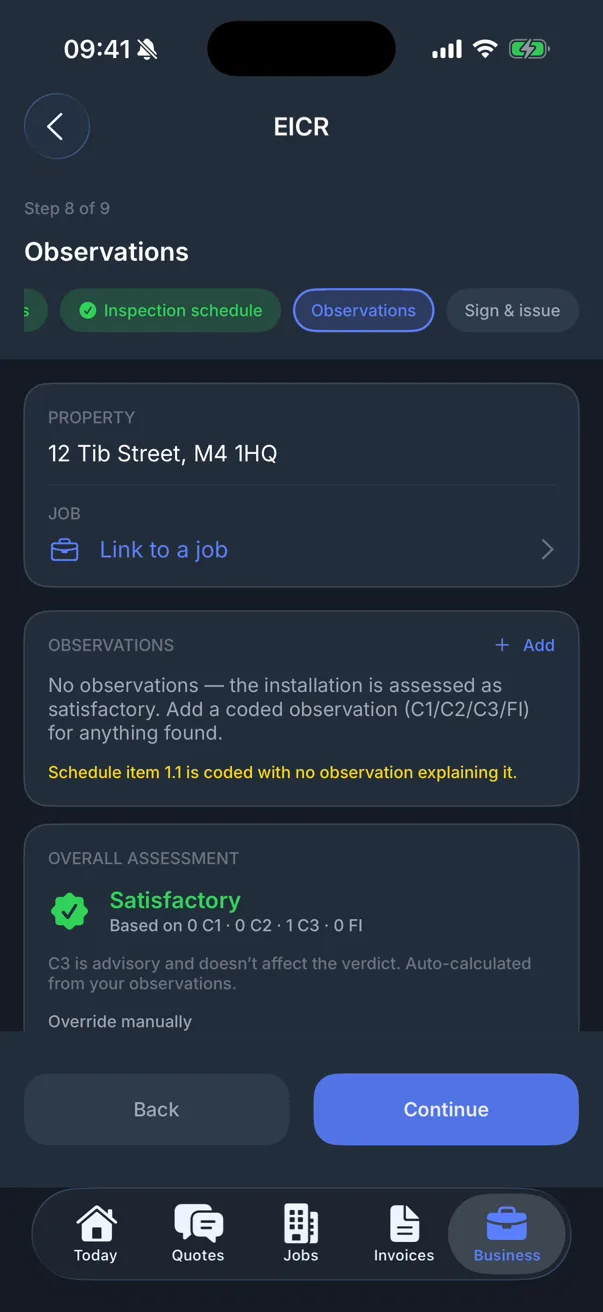
- FI no longer makes an installation unsatisfactory. Under Amendment 3 it did. Under Amendment 4 only C1 and C2 do.
- FI now reads "further investigation is advised", and the words "without delay" have been removed.
- Observations are split on the report into C1 and C2, which affect the overall outcome, and C3 and FI, which don't.
- The form carries the new edition reference, and the declaration should say which edition the inspection was carried out to.
PNB earthing on the forms
Protective neutral bonding is in BS 7671 for the first time. On the new certificate and report forms, TN-C-S earthing is recorded as either PME or PNB. If you can't tell which you have, NICEIC notes the network operator should tell you the earthing type free of charge.
Minor Works certificates
The Minor Electrical Installation Works Certificate now names the end to end ring readings r1, rn and r2, in place of the old L/L, N/N and cpc/cpc labels. It is a small change, but it means old pads and templates no longer match the model form.
Batteries: new Chapter 57
Home batteries are now common enough to get their own chapter. Chapter 57 covers stationary secondary batteries: selection and erection, protection against electric shock and thermal effects, isolation and switching, ventilation and fire protection. The old battery requirements in regulation group 551.8 have moved into it. The IET explains that batteries in dwellings are to be installed in line with PAS 63100.
If you inspect a property with a battery system, you will now be inspecting it against Chapter 57 too.
AFDDs
The AFDD requirement for socket outlet circuits up to 32 A has not been removed. It still applies in care homes, high rise residential buildings, HMOs and purpose built student accommodation. What has changed is the wording: "higher risk residential buildings" is now "high rise residential buildings", meaning buildings over 18 metres or more than six storeys. NICEIC also notes BS 7671 does not require AFDDs on circuits supplying battery energy storage systems.
Other changes
These come from the IET's own summaries. For the exact wording of any regulation, use the published book.
- Section 710, medical locations, has been substantially revised, with locations classed as Group 0, 1 or 2.
- A new Section 545 covers functional earthing for information and communication technology equipment.
- Section 716 on extra low voltage DC, including power over ethernet, has been updated.
- Regulation 551.7.1 now requires a suitable protective device where energy can flow in both directions.
What doesn't change
Existing EICRs stay valid until their next inspection date. Older installations don't fail because the standard has moved on: an EICR still asks whether the installation is safe for continued use. And the core test methods and limits you use every day carry on.
What to do before 15 October
Five things to sort this week.
- Get access to the 2026 book. NICEIC has said its registered businesses will need to show access to a copy of Amendment 4 to keep their certification.
- Update your certificate pads or software to the Amendment 4 model forms.
- Brief anyone who codes EICRs on the FI change, so reports aren't marked unsatisfactory for an FI alone.
- Learn how to identify PNB, and record PME or PNB correctly.
- If you fit or inspect home batteries, read Chapter 57.
Amendment 4 certificates in Traddie
Traddie's EICR, EIC and Minor Works certificates already follow the Amendment 4 model forms, including the C1 and C2 split from C3 and FI, and you can choose which edition a certificate is to. If you want the full process, read our step by step guide to doing an EICR, or our explainer on EICR codes.
Common questions
When does BS 7671 Amendment 4 come into force?
Amendment 4 was published on 15 April 2026 and could be used straight away. The previous edition, BS 7671:2018+A2:2022+A3:2024, is withdrawn on 15 October 2026, so from that date all new work and all EICRs should be to BS 7671:2018+A4:2026.
What is the biggest change in Amendment 4 for EICRs?
FI, further investigation, no longer makes an installation unsatisfactory. Under Amendment 4 only C1 and C2 observations do. The forms list C1 and C2 separately from C3 and FI.
Do I need to buy the new book?
If you design, install, inspect or test, you need access to the current edition. NICEIC has said businesses on its schemes will need to show access to a copy of Amendment 4 to keep their certification after 15 October 2026.
Does Amendment 4 make existing EICRs invalid?
No. A report done to an earlier edition stays valid until its next inspection date. Older installations are still judged on whether they are safe for continued use, not on whether they match the latest edition.
What is PNB earthing?
PNB, protective neutral bonding, is a form of TN-C-S earthing where the neutral and earth are connected at a single point near the supply, typically used for small supplies. Amendment 4 recognises it for the first time, so it is now an option on the certificate forms alongside PME.
Sources
- IET, IET and BSI officially publish Amendment 4 (2026) to BS 7671:2018, 15 April 2026
- NICEIC, understanding BS 7671:2018+Amendment 4:2026
- IET Electrical, ensure you are up to date with BS 7671
- IET Wiring Matters, the impact of Amendment 4:2026 on the 18th Edition
- NAPIT, statement on the publication of Amendment 4 (2026)